LGBTQ Representation in Board Games: Why Is It Still So Quiet?
Why does queer representation still feel rare in tabletop? A personal look at LGBTQ representation in board games, industry risk, “neutral” design, and why subtle inclusion isn’t always enough.
REPRESENTATION IN BOARD GAMES
2/22/2026
I think about this more often than I expected to.
We talk a lot about queer representation in video games. We celebrate canon lesbian characters, romance options, Pride cosmetics, explicit storytelling. But when it comes to board games? The conversation gets rather quiet.
And that quiet isn’t accidental.
When Games Avoid Identity Altogether
Board games, especially modern euro-style ones, often avoid identity altogether. You’re not playing “a lesbian merchant” or “a queer adventurer.” You’re trading spices. Building railways or managing a vineyard. Optimizing points. Many games abstract humanity out of the experience entirely. There are no faces, no dialogues, no relationships. Just systems.
On the surface, that feels neutral. But neutrality has a way of defaulting to whatever is culturally dominant. And when artwork does include people - couples on cards, characters in market scenes, families in rulebooks - they are very often heterosexual by default. Not aggressively so. Just casually. Automatically.
Board games don’t usually exclude queer people loudly. They just tend to forget us quietly.
It’s a Small Industry, and That Makes People Careful
Another part of it is industry scale. Board game publishing is smaller and more risk-sensitive than video games. Printing a board game is a financial gamble, and once it exists, it has to survive in a global marketplace. A publisher thinking about international sales might hesitate before including anything that could be labeled “controversial” in certain markets. When margins are tight, perceived risk feels bigger.
So inclusion, when it happens, often happens softly. In the background. A same-gender couple in a piece of art that isn’t mentioned. A gender-neutral rulebook. A character whose sexuality is never explicitly stated but not contradicted either.
And while subtle inclusion can be meaningful, it also means we’re often left scanning the table, wondering if we imagined it.
“It’s Just Mechanics” - Or Is It?
There’s also the argument that “board games are about mechanics, not identity.” I’ve heard that one. And I get it. I love mechanics. I love elegant systems and tight puzzles and clever card play. But mechanics don’t exist in a vacuum. Themes exist. Art exists. The worlds we build on cardboard still reflect choices.
If a game includes people, it is already making statements about who exists in that world.
Things Are Changing but Slowly
The good news? Things are changing for the better, albeit slowly. Crowdfunding has allowed more niche and identity-driven games to exist. More designers are openly queer. More publishers are thinking about inclusive art direction. We’re seeing games where queer relationships are built into the structure instead of added on later.
But compared to video games, tabletop still feels cautious. A few steps behind.
And maybe that’s why the moments of representation, when they do appear, hit differently for us. When we spot a same-gender couple in a cozy fantasy town. When a relationship game lets us play two women without turning it into a “variant.” When the rulebook simply assumes we’re there.
It shouldn’t feel radical. It shouldn’t feel surprising.
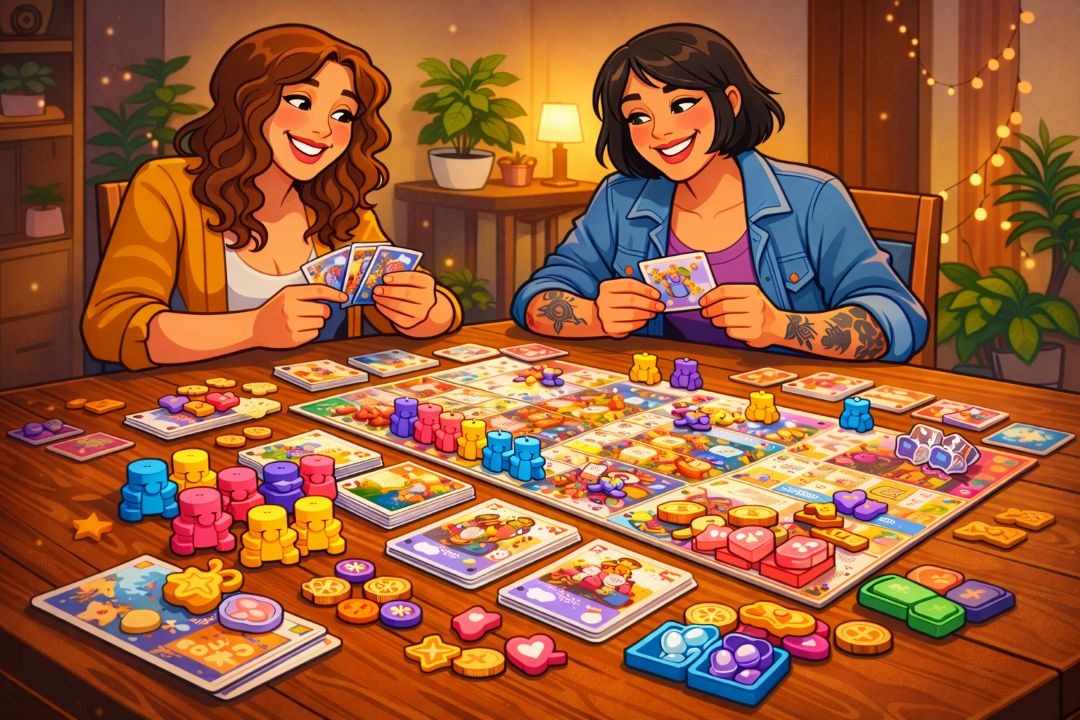
Queer people already sit at these tables. We already host the game nights. We already argue about rules and sleeve our cards and reorganize our shelves. The hobby isn’t separate from us.
The real question isn’t whether queer representation belongs in board games.
It’s whether board games are ready to fully acknowledge who’s already playing them.
Questions, thoughts, or book suggestions? Reach out!
© 2026 ChaoticSapphics. All content unless otherwise stated is owned by Chaotic Sapphics. All rights reserved.