This Is How You Lose the Time War – Book Review
A quiet, deeply personal reflection on This Is How You Lose the Time War - a poetic, sapphic love story told through letters, heavy but beautiful prose, and an ending that finally lets everything collide.
BOOK REVIEWS
2/10/2026
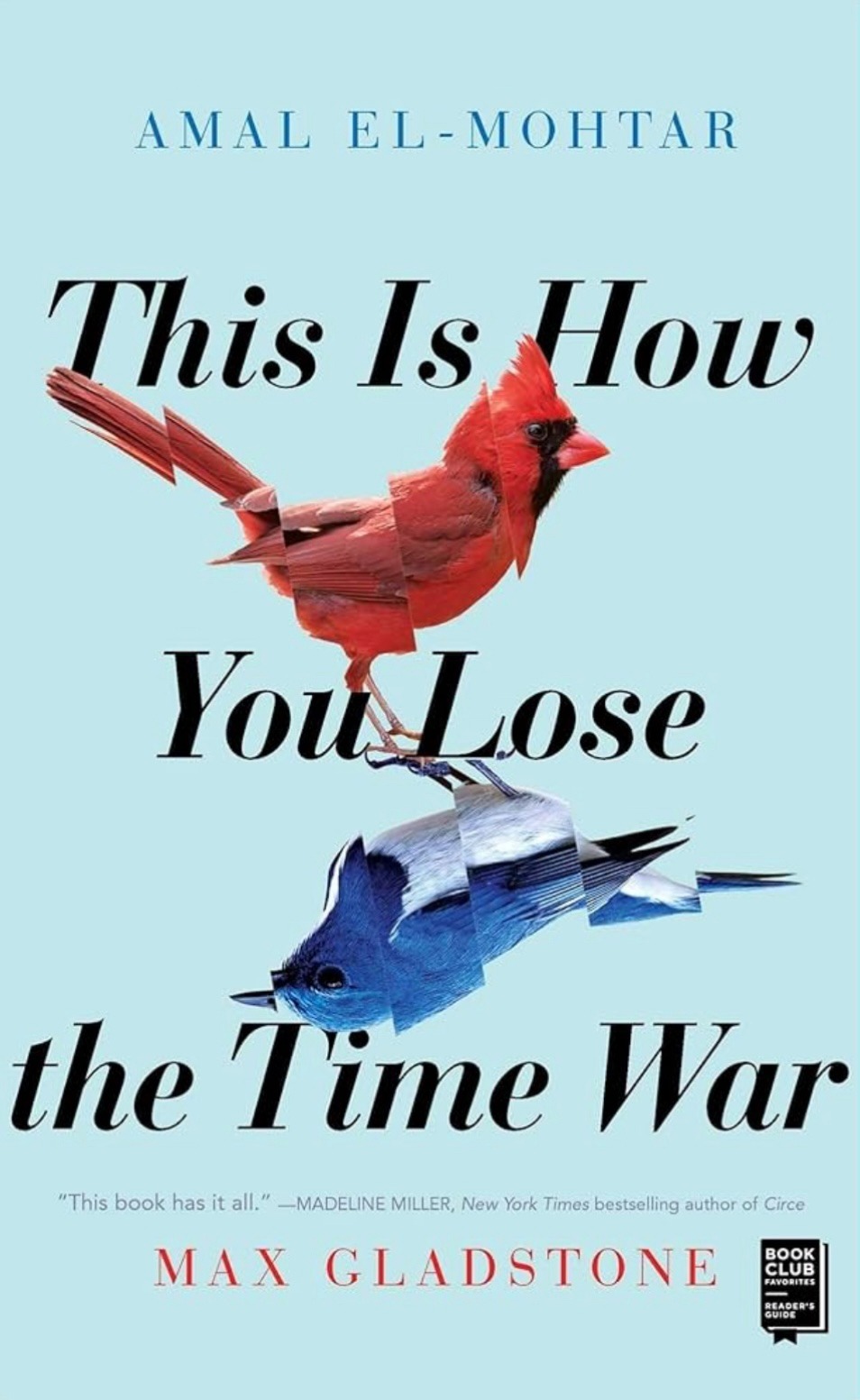
This Is How You Lose the Time War is one of those books that doesn’t rush to explain itself. It trusts you to feel your way through it first, and that trust is a big part of why it worked so well for me. From the very beginning, it asks you to surrender a bit: to accept fragments, impressions, emotions before logic.
Subtle, sapphic, and deeply intimate
What I loved most about this book is how quietly intimate it is. The relationship between Red and Blue doesn’t announce itself or demand attention. It unfolds in fragments: letters left behind like secrets, fleeting glances across impossible timelines, small acts of curiosity that slowly become care. Their connection grows in the margins of the story, in what’s implied rather than what’s spelled out, and that restraint makes it feel incredibly real.
It’s unmistakably sapphic, but never sexualized or framed for consumption. There’s no moment where the story tries to justify their feelings or turn them into a spectacle. Instead, the love lives in obsession and recognition. In the way they begin to look for each other, even when they’re supposed to be hunting one another down. In the slow, almost frightening realization that the enemy on the other side of the war might be the only person who truly understands your mind, your loneliness, your way of existing in the world.
That subtlety meant a lot to me. As a queer reader, it felt rare and deeply affirming to see a lesbian connection treated with such care. The book doesn’t rush intimacy or force it into familiar shapes. It allows tenderness to grow naturally, through words and shared intellect and longing stretched across time. It knows exactly how much to say, and just as importantly, when to stay silent — trusting the reader to feel what’s there without needing it spelled out.
Beautiful prose, but not always easy
Reading this book felt like leaning in close, like listening to someone speak in a hushed voice and realizing you might miss something important if you don’t give it your full attention. The prose is dense and intensely poetic, often more concerned with mood and emotion than with clarity. Sentences spiral, images pile on top of each other, and meaning sometimes feels just out of reach. There were moments where I had to pause, reread entire passages, and eventually accept that I wasn’t meant to fully understand every mechanic of the time war or every shift in reality.
The writing can feel heavy, even overwhelming, especially if you’re expecting clean explanations or traditional sci-fi logic. At times it borders on confusing, and I can easily imagine it being frustrating if you’re tired, distracted, or not in the right headspace. This is not a book you skim. It asks you to slow down, to sit with uncertainty, and to let feeling come before understanding.
But for me, that confusion ended up feeling intentional rather than careless. It mirrors the story itself. Time is fractured, constantly rewritten, collapsing and reforming under the characters’ feet. Loyalties blur. Identities shift. Nothing stays still long enough to be neatly explained or comfortably mapped out. The disorientation of the prose puts you in the same unstable space as Red and Blue, where certainty is impossible and meaning has to be felt rather than proven. Once I stopped fighting that and leaned into it, the writing became less of an obstacle and more of an experience in its own right.
An ending that hits hard
And then there’s the ending. After so much restraint, distance, and quiet longing, the final pages suddenly surge forward with an almost startling intensity. The story, which has spent so much time circling emotions and ideas, finally lets everything collide. Action rushes in, timelines tighten, and consequences that have been patiently waiting finally demand to be faced.
What struck me most is how earned it feels. The sudden momentum doesn’t come out of nowhere; it’s the release of everything that’s been building beneath the surface. The tension, the yearning, the unanswered questions all snap into motion at once. It’s fast and emotionally charged, but never sloppy. Every moment feels purposeful, like the book has been holding its breath just to let go all at once.
I finished the last pages with that rare sense of completion, the feeling that the story knew exactly when to stop and exactly how to get there. The ending doesn’t just resolve the plot, it honors the emotional journey that came before it. I closed the book feeling full, a little breathless, and deeply satisfied, like the story had landed precisely where it was always meant to.
Why it stayed with me
This Is How You Lose the Time War isn’t a book I devoured for plot clarity or worldbuilding logic. I read it for the ache of connection, for the beauty of two women finding each other across impossible distances, and for the bravery of a story that lets love exist without needing to explain or justify itself. It lingered with me long after the last page, and honestly, I think that’s the highest compliment I can give it.
7,5 out of 10
Questions, thoughts, or book suggestions? Reach out!
© 2026 ChaoticSapphics. All content unless otherwise stated is owned by Chaotic Sapphics. All rights reserved.