
Avoidant vs Anxious Attachment in Relationships: Real-Life Examples and What Actually Helps
Avoidant vs anxious attachment can feel like emotional whiplash. Through real-life relationship examples, we break down how each partner experiences stress, conflict, and closeness, and what actually helps heal the cycle.
ATTACHMENT CHAOS
2/28/2026
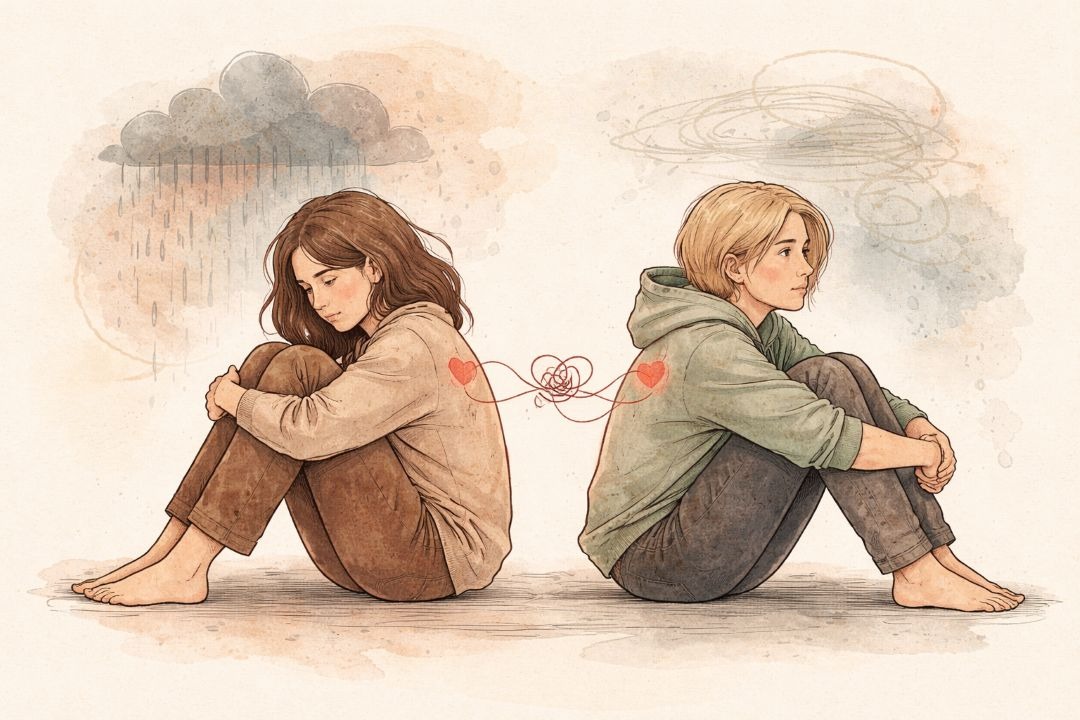
When people talk about anxious and avoidant attachment styles, it often sounds clinical. One partner fears abandonment. The other fears intimacy. One chases. One withdraws.
But inside a real relationship, it rarely feels that neat.
What it actually feels like is this: you can both be standing in the same room, living through the same situation, and experiencing two completely different emotional realities. Not because one of you cares more, or because one of you is dramatic and the other cold, but because your nervous systems learned very different ways to stay safe in love.
In our relationship, this difference shows up in ordinary, everyday moments. Not grand betrayals. Not dramatic storylines. Just stress, conflict, closeness, silence. The kinds of things every couple encounters.
And yet those small moments can activate something very old in both of us.
Before we move into our real-life examples, it helps to briefly ground what we mean by anxious and avoidant attachment.
Anxious attachment in relationships often looks like heightened sensitivity to shifts in connection. When something feels uncertain, the anxious nervous system activates quickly. Silence can feel loaded. Distance can feel threatening. Reassurance becomes regulating. Closeness restores safety.
Avoidant attachment, on the other hand, tends to activate around emotional intensity and perceived pressure. When things escalate or feel overwhelming, the instinct is to create space. Independence regulates. Solitude restores balance. It isn’t a lack of love, it’s a protection strategy.
Understanding that framework changed how we see each other. But the real work happens in specific moments.
When Stress Turns Into Withdrawal
The first pattern we had to really confront was what happens when I’m overwhelmed.
If I’m sick, exhausted, or stressed from work, something in me quietly retracts. I become more inward. I talk less. I engage less emotionally. We started calling it “cocoon mode” because that’s genuinely what it feels like, like my system is pulling everything inward to conserve energy.
Inside my own body, this feels protective and necessary. It has nothing to do with the relationship. I’m not angry. I’m not secretly upset. I’m not reconsidering us. I’m simply regulating by reducing stimulation.
But for my wife, who leans anxious, that same shift feels destabilizing.
When I withdraw, her system doesn’t experience it as neutral. It experiences it as change. And change, in an anxious nervous system, can register as threat. She starts scanning for meaning. Did something happen? Did she miss a signal? Is there tension that hasn’t been named?
What feels like relief to me feels like danger to her.
We’ve talked about this dynamic many times, and what we realized is that it isn’t my need for space that triggers her most, it’s the ambiguity around it. When withdrawal has no explanation, her mind fills in the blanks.
So now, when I feel myself starting to cocoon, I try to name it out loud. Something as simple as, “I’m really overstimulated and tired. I love you. I just need some quiet time to decompress,” changes the entire atmosphere. The space remains, but the mystery disappears.
For someone with anxious attachment, uncertainty is often the sharpest trigger. Language softens that edge.
When Conflict Pulls Us in Opposite Directions
Arguments are where our differences become impossible to ignore.
Even small disagreements can activate something bigger underneath. When tension rises between us, our instincts diverge almost immediately. As the more avoidant partner, escalation feels overwhelming very quickly. When voices shift or emotions intensify, my body reacts before I consciously decide anything. My instinct is to create distance. I want to step away from the room, lower the temperature, regulate on my own.
It isn’t about winning the argument or refusing to engage. It’s about how my system processes conflict. Intensity feels like threat, and distance feels like safety.
For my wife, that same moment feels completely different. When she senses me pulling away, panic begins to rise. She doesn’t want distance - she wants resolution. She wants to talk it through immediately, to close the gap, to be held so she doesn’t feel abandoned in the middle of tension.
Her instinct is to move toward. Mine is to move away.
The more I withdraw, the more urgent her need for connection becomes. The more she pushes to repair in the moment, the more pressure I feel to respond when I’m already flooded.
She experiences abandonment. I experience engulfment.
We understand this intellectually now. We can describe it calmly when we’re regulated. But living it in real time is different. In the heat of conflict, we are not just choosing behaviors; we are fighting instincts wired deep into our nervous systems.
Healing here has meant doing the opposite of what feels natural. I practice staying in the room even when every part of me wants to leave. She practices allowing space even when every part of her wants to close the distance immediately. It is uncomfortable for both of us. It does not feel intuitive yet.
But staying connected inside conflict - rather than escaping or escalating it - is the work.
When Physical Closeness Means Different Things
Attachment differences also show up in something much softer: everyday affection.
My wife thrives on physical and emotional closeness. A hand on her back while passing by. Holding hands on the couch. A quick hug in the kitchen. These gestures aren’t small to her; they are regulating. They reassure her body that we are steady.
I, on the other hand, can become mentally absorbed in whatever I’m doing. When I’m focused or preoccupied, I don’t always notice that I haven’t initiated affection in a while. It isn’t intentional neglect. It simply doesn’t register as urgently in my system because I don’t measure connection through frequency of touch in the same way.
While I’m content internally, she may begin to feel the absence. The longer the gap stretches, the more her mind starts to interpret it. Has something shifted? Is she pulling away? Did I do something?
Often, I remain unaware until her anxiety reaches the surface. When she seeks reassurance urgently — clinging closer, asking for more physical closeness — it can suddenly feel like pressure to perform affection on demand. That sense of pressure activates my avoidant tendencies, even though the original issue was simply a difference in awareness.
What has helped us is not waiting until she is already spiraling. I try to step out of my mental loop and intentionally notice her. I ask myself when I last reached for her without prompting. Even something small - brushing her hair back, giving her a quick back rub, squeezing her hand - interrupts the cycle before it escalates.
And what I’ve realized is that those moments ground me too. They pull me out of my head and into the relationship. What once felt like pressure now often feels like a choice to connect.
Why This Dynamic Feels So Intense
The anxious–avoidant dynamic can feel dramatic, but at its core, it’s two protection strategies colliding.
The anxious partner moves toward connection when stressed. The avoidant partner moves toward space. Neither is trying to hurt the other. Both are trying to stay safe.
In queer relationships, this can sometimes feel amplified. Many of us didn’t grow up seeing secure models of love that reflected us. Some of us learned early that connection could be withdrawn or rejected by the world around us. Attachment patterns don’t exist in isolation; they are shaped by history.
Understanding that has allowed us to approach each other with more compassion. Not perfection - we still fall into old patterns - but awareness.
Can Anxious and Avoidant Attachment Work?
We don’t believe this dynamic is doomed. But it does require intention.
It requires naming what is happening beneath the surface instead of attacking each other’s character. It requires reassurance that doesn’t feel forced, and space that doesn’t feel like silent punishment. It requires both partners to stretch beyond their instinct at times.
Most importantly, it requires recognizing that the other person’s reaction is not an accusation. It is a nervous system response.
We are still learning. We still get it wrong. But we’ve moved from seeing each other as the problem to seeing the pattern as the problem.
And that shift has changed everything.
If you’re curious how this dynamic played out in our own relationship over time, we’ve written about our experience with anxious and avoidant attachment in a lesbian relationship - what it looked like, and what started to shift. And if you're currently stuck in the pining phase, read our guide on how to break the Great Lesbian Standstill.
Questions, thoughts, or book suggestions? Reach out!
© 2026 ChaoticSapphics. All content unless otherwise stated is owned by Chaotic Sapphics. All rights reserved.